Ultraviolet photons from O and B stars strongly influence the structure and emission spectra of the interstellar medium. The UV photons energetic enough to ionize hydrogen \(h\nu > {\rm 13.6 eV}\) will create the H II region around the star, but lower energy UV photons escape. These far-UV photons (\(6~{\rm eV} < h\nu < {\rm 13.6~eV}\)) are still energetic enough to photodissociate molecules and to ionize low ionization-potential atoms such as carbon, silicon, and sulfur. They thus create a photodissociation region (PDR) just outside the H II region. In aggregate, these PDRs dominates the heating and cooling of the neutral interstellar medium. The gas is heated by photo-electrons from grains and cools mostly through far-infrared fine structure lines like [O I] and [C II].
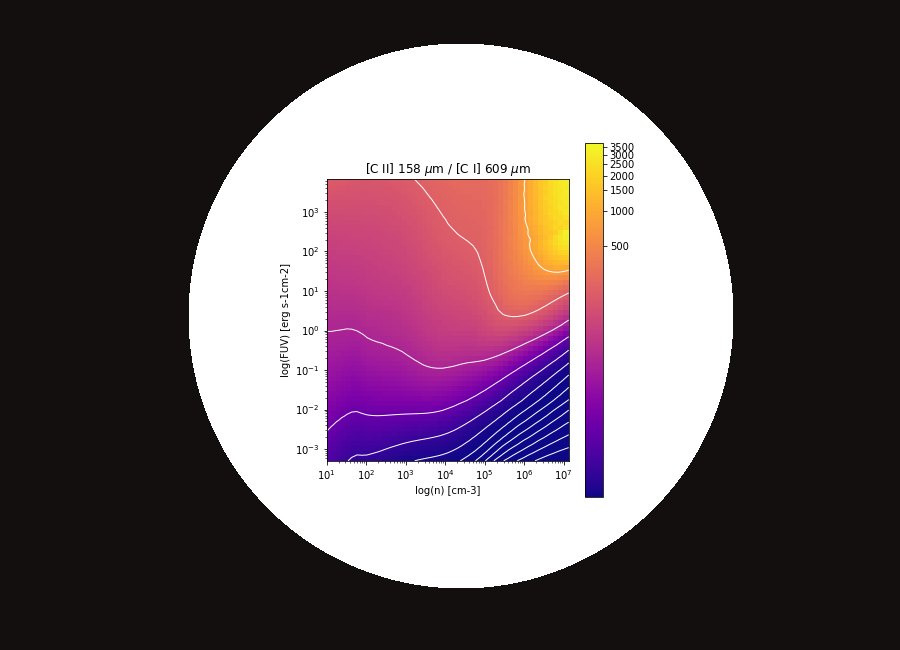
The PDR Toolbox is an open-source, science-enabling tool for the community, designed to help astronomers determine the physical parameters of photodissociation regions from observations. Typical observations of both Galactic and extragalactic PDRs come from ground- and space-based millimeter, submillimeter, and far-infrared telescopes such as ALMA, SOFIA, JWST, Spitzer, and Herschel. Given a set of observations of spectral line or continuum intensities, PDR Toolbox can compute best-fit FUV incident intensity and cloud density based on our models of PDR emission. One can also fit H2 rovibrational emission excitation diagrams to determine temperature, column density, and ortho-to-para ratio.
The current version is 3.0.1 (released August 25, 2026)
Release Highlights
Small Magellanic Cloud Models
The SMC models have been completely updated using SMC metallicity, abundances, cosmic-ray ionization rate, extinction curve, the improved WK2020 code, and the full range of viewing angles.More molecules added to excitation fitting
Excitation diagrams for C18O, 13C18O, and CH+ can now be fit, with partition functions drawn from HITRAN and EXOMOL, and transition data from Meudon PDR7 code.Users can limit the model ranges when fitting line ratios
Limiting the density and radiation field allowable ranges can help prevent unphysical solutions that are not excluded by the data.Performance improvements
Both radiation field/density fitting and excitation diagram fitting now fit multi-pixel maps 2x-11x faster.New and updated notebooks
The Example notebooks have been updated and a new notebook added show how to fit H2 excitation on spatial maps.Other changes and bug fixes
We have made several enhancments and bug fixes. Thanks to users who reported issues or asked for new features!
..and more
The full list of changes can be viewed on our github.
Reference Paper on PDRT
The PhotoDissociation Region Toolbox: Software and Models for Astrophysical Analysis,Marc W. Pound & Mark G. Wolfire 2023, AJ, 165:25
Read it here.
Please remember to cite use of the PDR Toolbox!
Reliable Astrophysics at Everyday Low, Low Prices! ®